DADS In Vehicle · Communication system operator interface
Want a multi function, scalable platform for playback and repetition of audible and visual information? DADS is the solution for medium to large scale public address, text display, paging (both pre-recorded and live) and intercom applications.
DADS supports up to two channels of audio playback. Typically these channels are used for public address, passenger information and advertising purposes. Beneficial in applications such as in-vehicle where a message plays inside the vehicle while a different message plays. The DADS is able to associate text messages with the pre-recorded audio announcements. This allows the system to provide simultaneous audible and visual messaging.
Overview
Key features
- Automatic messaging system
- Handset interface
- Convenient route updates
- Computer interface
- Vacuum fluorescent display
- Monitor speaker
- MackNet interface
- Public address system interface
- Intercom interface
- Passenger emergency communication interface
Applications
- Public address
- Passenger information
- Advertising
- Text display signage
- Paging, pre-recorded and live
- Intercom
- Americans with Disabilities Act (ADA) compliance
Specifications
| Audio | |
|---|---|
| Channels | Up to 2 audio playback channels |
| Text | Text messages linked to the audio announcements |
| Monitor | Monitor speaker |
| Audio coding | MPEG, 16 bit, mono |
| Bandwidth | 20 Hz – 20 kHz, ±1 dB |
| Dynamic range | 90 dB |
| Signal to noise | 90 dB |
| Distortion (THD) | < 0.1% |
| Output | 150 Ω, +4 dB, single ended or balanced; 5 W amplifier for the internal speaker |
| Interfaces | |
| Audio systems | Public address, intercom, passenger emergency communication |
| Operator | Handset; vacuum fluorescent display |
| Data | Computer, MackNet |
| Serial | Train line RS485, 115.2k; local computer RS232, 115.2k |
| System | |
| Messaging | Automatic messaging system |
| Routes | Convenient route updates |
| Memory | FLASH EPROM, standard PC card |
| Physical | |
| Power | 24–90 VDC, automatic; 1 A at 24 VDC; 2 A fuse |
| Dimensions | 10″ W × 8″ D × 4″ |
| Weight | 5 lb |
| Mounting | Flanges with mounting holes; 18 gauge steel, 1/8″ aluminum front panel |
| Operating temperature | −20 to +60 °C |
| Environmental | Storage −40 to +70 °C; vibration 1.5 G RMS, 5–150 Hz operating, 8 G RMS, 100–1,100 Hz endurance; shock 30 G peak, 6 ms |
User manual in brief
System overview
Mackenzie’s Digital Audio/Display System (DADS) is a multi function, scalable platform for playback and repetition of audible and visual information. Originally designed for compliance with the Americans with Disabilities Act (ADA), it serves medium to large scale public address, text display, paging (pre-recorded and live) and intercom applications. The base system offers features that are populated selectively for each application.
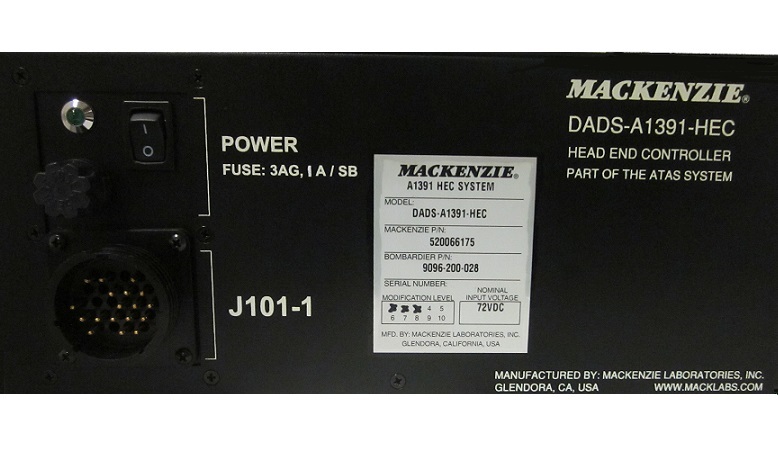
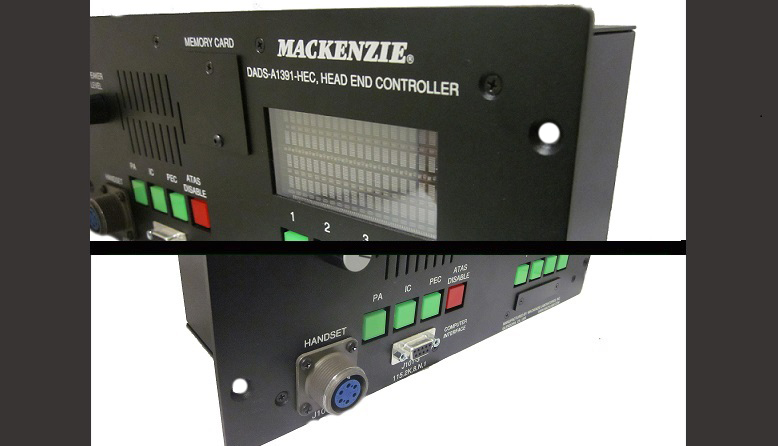
- Head End Controller (HEC): the operator interface, with handset, 20 × 4 character vacuum fluorescent display menu system with soft keys, USB and RS232 ports, and a wheel counter / zero speed input.
- In Car Communications Unit (ICCU): plays the announcements and routes audio to the speaker networks of each car, with access to its memory card.
- Passenger Emergency Communication (PEC) panels, for passengers to call the operator.
- LED signs, internal or external, for text messages.
Audio, amplification and page stacking
- 1 or 2 audio playback channels, typically for public address, passenger information and advertising. With two channels, different messages play in different zones at the same time, for example one inside the vehicle and another outside.
- Audio stored with standard ISO MPEG compression, 32 to 128 kbps, to save memory with minimal effect on quality.
- 1 or 2 channel amplifier section driving the speakers directly, up to 100 W; 70 V distribution for large speaker networks. It saves an external amplifier, consolidates power supplies and reduces space and wiring.
- Amplifier options: a microphone station for live public address and intercom; Automatic Level Control (ALC) circuitry and microphones that adjust levels to the ambient noise.
- Page stacking (optional): for high traffic paging systems, records, stores, plays and repeats incoming pages, eliminating feedback, waiting on a busy paging system and message overlap.
Memory, text and signage
- Removable, non-volatile flash memory for audio, text and program; data stays intact during a power outage. Program changes are as simple as changing the card, and larger cards hold longer programs.
- Data is stored in DOS format, so parts of the audio memory can be changed or added without rewriting it all, also over serial communications.
- Text messages are associated with the pre-recorded audio, for simultaneous audible and visual messaging, and sent to LED or LCD signs over RS-232, RS-422, RS-485 or J1708 using the sign manufacturer’s protocol.
- Compatible displays include LED, LCD and flip dot signs in many character sizes, widths and colours; several signs can show the same text across the vehicle. Mackenzie has drivers for many signs and writes new ones as needed.
Communications, inputs, outputs and power
- Protocols: RS-232, RS-422, RS-485, CANBus and J1708 / J1587, several at once; up to eight simultaneous communication ports.
- Relay outputs: Form C dry contacts give system status to external equipment, with isolation between the DADS and that equipment; as many as the application needs.
- Contact inputs: optically coupled, powered from an internal isolated supply for galvanic isolation from third party equipment; as many as the application needs.
- Power: nominal 12 VDC (9–32 VDC), 24 VDC (16–36 VDC), 48 or 72 VDC (24–90 VDC), or mains AC (85–264 VAC).
- Mechanical: equipment with a user interface is kept small; the rest of the circuitry goes into gear hidden in a closet or equipment rack. Mackenzie can develop enclosures for any installation.
Composer, recording and updates
The memory card holds the “composer”, Mackenzie’s name for the configuration of audio, text and control information, including route layout, recorded announcements, text association and activation points.
- Factory programming: turnkey production of the composer, with live announcement service, programming and duplication, from the client’s route layout with activation points and audio and text message scripts. Many voice types and styles are available; samples on request.
- Voice Recording Station: software for clients to create their own composer and configure all pre-recorded audible and visual playback.
- Memory card replacement: cards are removed, programmed and replaced, or swapped for new ones; the memory size can change with the application.
- Delta Download: changes only a single message, configuration or firmware over an auxiliary serial port or a specially formatted card in the active Head End Controller, minimizing download time.
- USB memory key (optional): downloads the complete composer, or part of it, from a specially formatted key.
- Optional local recording: records the ALC, PEC and operator public address and intercom microphones in MPEG format, offloaded by memory card or USB key.
Rail example, DADS-A1391 ATAS
Mackenzie’s block diagram E3585 shows a DADS-A1391 system for a train of cab car, coach cars and locomotive. Each car has an ICCU with 70 V / 50 W outputs to 8 interior speakers and to right and left exterior speakers, PEC panels (one in the cab car toilet room), door control panels, 8 internal 7 × 96 LED signs and 2 side 7 × 120 LED signs, and a power converter from mains to 24 VDC. Each end has a HEC. Train lines carry PA audio, intercom audio, PEC audio, RS485 data and power.
- Route messaging: the active HEC tracks the vehicle by wheel counter or odometer; at pre-programmed waypoints it plays the message on its local speaker and sends a play command to each ICCU over the RS485 train line; each ICCU plays it on the specified speaker network and sends the text to the specified signs in its car.
- Passenger emergency intercom: a passenger presses the call button on a PEC panel; its microphone is routed to the active HEC over the PEC audio lines, and the operator answers over the half duplex PEC audio link. Further PEC calls join the conversation in “party line” mode.
- Operator / conductor intercom: activated at the HEC or a door control panel; a sounder alerts the other panels, and audio goes to the active HEC and all door control panels over the intercom audio lines, in “party line” mode.
- Public address: activated at the HEC or a door control panel; audio goes to all ICCUs over the PA audio lines, and each ICCU routes it to the speaker network selected by the door control signals. A page anywhere on the consist stops any playing pre-recorded message.
Environmental qualification
Each agency has its own environmental requirements. Mackenzie has designed and verified DADS equipment to, and passed, the following tests.
- Operating temperature −30 °C to +60 °C; storage −40 °C to +70 °C; humidity 98% at +60 °C.
- Shock 30 g, 6 ms; operating vibration 4 g RMS, 10–150 Hz; endurance vibration 8 g RMS, 100–1100 Hz random.
- Splash and dust proof sealing; splash and salt spray; load dump.
- EMI to FCC Part 15 / EN55022; immunity to EN61000-4-2 (electrostatic discharge), -4-3 (radiated RF fields), -4-4 (fast transients and bursts), -4-5 (surge), -4-6 (conducted RF), -4-8 (power frequency magnetic fields) and -4-11 (voltage dips and interruptions).
Documents
| Document | Content | Format |
|---|---|---|
| Spec sheet | Specifications | |
| Operation guide | User manual, version Rev 2 | |
| Quikey: connectivity detail | Connectivity detail |
Images
Related models: Transit
| MB-701 | In-vehicle automatic announcement system | |
|---|---|---|
| DADS In Vehicle | Communication system operator interface | This page |
| DADS Platform | Audio/visual public access system |